March 18, 2009

Better off watching on Hulu, in bed with my cat

I'd seen the promos for Better Off Ted, but was planning to resist watching because THERE'S TOO MUCH GOOD TELEVISION ON THESE DAYS, GODDAMNIT and I don't need another must-see show. Terminator, Lost, Chuck, 30 Rock, Fringe, ... thank god for Hulu.

Better off Ted is a satirical comedy about a company called Veridian Dynamics that manufactures everything from office chairs to "that thing, with all the gears," and, by the way, how much do I love that they created a fictitious corporate website for the company? Oh yeah, that much! They had me at the opening credits, which are designed to look and feel like a corporate advertisement.

The main character, Ted, talks directly to the camera. I haven't seen that gimmick since Moonlighting, and I still miss it. I'm not ashamed to admit, I love shows with a gimmick, and Better Off Ted has several. When he goes home from the office, Ted gets advice from his five year old daughter. She's the voice of reason among a sea of crazies.

Portia de Rossi is terrific. What an inspired bit of casting. She plays the emotionless Veronica Parker, who regularly enters Ted's office with orders from above. That is from the company, which she refers to as They. As in, "They want a mouse that can survive temperatures of 120 degrees."

The show has great writers. Here's just a sample of memorable lines from the pilot:

"We want to weaponize a pumpkin."

"Can a company be bitchy?"

"Making toast is fine, you do it well, but you need more."

"I used up my office affair. You only get one."

"And so, they froze Phil."

February 22, 2009

Angelina Jolie is making me rethink my tattoo

The Super Bowl is all about the advertising, with a football game going on in the background. The Oscars are all about the dresses, and something about movies. This year, when I watched the Super Bowl I found myself learning some of the rules of football. Tonight, I learned some of the rules of Oscar. Allow me to share.

If you are the unknown escort of a Hollywood hunk, wear the ugliest dress you can find. Work hard at it, because everyone hates you anyway.


If you're a foreigner, go for the respect me or I might kill you look.


When no one knows your name, try to make the worst dressed list, because there's no such thing as bad publicity.


When you've reached the A list, you can get away with wearing anything.


If you're just coming off a stint in anorexia rehab, flaunt it.


Play to your strengths, even if you left them in the 80s.


Models have a different set of rules. Something to do with wearing a dress that looked better on the hanger, and should have been left there.


If you wait long enough, you get a pass.


Don't wear a dress that might poke you in the eye during the ride to the show. It'll make your face look like this.


Let the professionals clean the fish.


Unwrap the box the dress came in.


And finally, no matter how weirdly creepily beautiful you are, remember to wash off the stamps from last night's clubbing before dressing up.

February 17, 2009

All the World's A Stage, and Joaquin Phoenix is a Player

I assume by now you've all seen the Joaquin Phoenix interview on Letterman. I won't bother to link to it on YouTube, because CBS keeps pulling it down (as rightly they should). Besides, if you're reading this, you're savvy enough to find it for yourself.

The chatter in the blogosphere is waxing that Phoenix must have been on drugs, or otherwise lamed out. It was, as you saw, a ridiculously lame performance. He mumbled. He gave one word answers. He seemed baffled by Letterman's questions.

Until Letterman started mocking him, that is. Until, like Harvey Korman on the Carol Burnett show, who occasionally succumbed to a smirk, if not outright losing it, in response to Tim Conway — Phoenix lost his composure. Just for a nanosecond; if you weren't paying close attention, you probably missed it.

So go watch the video again, and look for it. There, see?

I have a confession to make: I'm extremely gullible. My good friends know this. I will believe just about anything, if someone I trust tells it to me. And when they're pulling my leg, it takes me longer than the average bear to get it.

But I got Joaquin Phoenix on Letterman. I got that it was a performance. To what end, I don't know, but I'm sure we'll eventually find out. There's no way that was an accident, or a PR misstep. There's just no way.

No Hollywood celebrity goes on a talk show unprepared, uncoached, un-made up, or un-styled. They all have people — publicists, stylists, hair dressers and makeup people. Advisors.

(Well, maybe all but Michael Jackson. But I digress.)

I think Rolling Stone got it right: it was an act. It was like Borat. If you saw that movie, didn't you wonder how the people he was with could have been fooled into believing he was playing it straight?

Same thing. Joaquin Phoenix is up to something. I hope, when we find out what it is, it's one quarter as good as Borat was.

I love David Letterman, though. (My good friends also know that about me.) And at the end of the interview with Joaquin Phoenix, Letterman had the greatest last words: "We owe Farrah Fawcett an apology!"

(I don't think that one was an act.)

February 14, 2009

My Covert Mission to Undermine Unethical Facebook Ads and Save the World From Communism

Here's the objection I have to ads on Facebook like the ones you see here: They're unethical.

Because they're unethical, it is my opinion that Facebook should not allow them. Someone at Facebook screens all ads before giving the go-ahead to allow them to be posted, but they don't seem to consider these ads impermissible. I do, and so should you.

Why are they unethical? Because the advertiser has not licensed — that is, paid for the right to use — Julia Roberts's image. Or Jennifer Aniston's. Or Sandra Bullock's. Or Kelly Ripa's. You might be thinking, oh, who cares, they're big celebrities, they have lots of money, so it's OK for a small business to steal their image and use it for their own purposes.

You are wrong. Here's why.

To any professional who knows anything about business, marketing, or advertising, these ads positively scream amateur! Because professionals know that you can't just appropriate the image of Mickey Mouse or Homer Simpson for use in your promotional materials. You have to negotiate, and pay for it. Jennifer Aniston's people may not be patrolling the Internet for the unauthorized use of her image, but I dare you to try using a Disney character without permission. (Go ahead, try it. You'll be shocked at how quickly the Disney people will come down on you.)

The advertisers that post these unethical, amateur-style Facebook ads are using a technique called manufactured credibility, which is something professional marketers do when they don't have any real credibility. If you can't get a doctor to be an official spokesperson for your vitamin supplement, hire an actor and dress him in a white coat. Manufacture credibility. There's nothing unethical about this technique, so long as the actor doesn't actually say, "I am a doctor." You can't outright lie in advertising, but you can mislead like hell.

The snake-oil salesmen behind these Facebook ads are attempting to mislead you into believing that these celebrities use their products. If you believe that, even a little bit, then you are a moron.

Finally, consider this: Philosophically speaking, the idea that any artist's images, or words, or art, should be free for all to use for any commercial purpose is, essentially, communistic. This is America. Is that really how you want to roll?

So, what is my covert mission? Every time I see one of these ads on my Facebook page, I click on it ten times. The advertiser pays per click, which means every time I click on it, it's costing them money, and they're getting nothing for it because I'm not following through to purchase their miracle diet products or wrinkle cream.

I encourage you to join me in my mission.

February 7, 2009

Advertising & the End of the World

"Advertising does not stress the value of a long range collective future...the prevailing values of the commercial system provide no incentive to develop bonds with future generations...

"We don't care about the future.

"To the extent that it does all these things, advertising becomes one of the major obstacles to our survival as a species."

So narrates Sut Jhally, author of several books on the intersection of advertising and culture, catastrophe, and fetishism, in a documentary film titled "Advertising & The End Of The World."

Judging by the five minute preview available on the publisher's website, this film looks almost as scary as An Inconvenient Truth.

I'm working on getting it for my classes.

January 31, 2009

Truth In Advertising

Apparently that was the original title of the new show that started airing this week, Trust Me. Not to be confused with the video called Truth in Advertising, that was made back in 2000 for a Canadian advertising awards show (and features Colin Mochrie).

Canadians are everywhere it seems: both Eric McCormack and Tom Cavanagh, the stars of Trust Me, are Canadian. McCormack named his son after Casey & Finnegan from Mr Dressup; and Cavanagh used to do commercials for Labatt Blue. (He was the guy standing on the dock on a lake up north, who looks at his Blue with love, then at the lake with scorn and says, "If I'd wanted water, I would have ordered water." Remember? Yeah, that guy.)

But I digress.

The best scene in the pilot comes early, just before Stu, the Group Creative Director, drops dead of a heart attack. He delivers a long, ranting speech that ends with, "Clients are idiots!"

(At that moment, everyone watching the show who has ever worked in an agency stood up and cheered.)

I wish I could find the clip on TNT's website, or on YouTube, but I can't. So you'll just have to bittorrent it.

If you did watch the pilot, didn't you just cringe with embarrassment when the weasely creative director, Simon, was pitching his lame idea for Arc Mobile to the client? Pointing at stock photos of people skateboarding and whatnot, while the lamest George Michael song in the world played in the background?

I know, "lamest George Michael song" is something of an oxymoron. Or something. Gak; now I'm going to have that execrable song stuck in my head for a week. Really, it's worse than Hotel California.

But I digress.

Trust Me is a must-watch for anyone interested in advertising. Are you listening, my students? I'm adding it to my appointment TV list, because it's not available on Hulu and, well, it's just too good to miss.

(Personally, I thought Spartexticus was a clever idea. Which is probably why I'm not a Creative Director.)

November 21, 2008

More Delicious than Delicio.us

Delicious, Reddit, Digg — they're all so 2007. Besides, they have nothing to do with advertising.

This site does: Adverlicio.us. It's an online archive of online ads. Like this terrific interactive banner ad for Volkswagen, which encourages you to drag and drop the features of the car onto the car, right in the ad. (Click on the image below to see the live ad.)


Aspiring creatives, take note: If you have the skills and talent to create ads like this one, you'll get hired, even during a recession.

November 14, 2008

Boom Boom in the Routan Room


If you've seen the TV commercials for the Volkswagen Routan, the ones featuring a perfectly cast, perfectly straight-faced Brooke Shields lamenting the growing social problem of women having babies just for German engineering, then you know that it's a beautifully executed satire. You know that she's not suggesting that women are really doing this, any more than Jonathan Swift was really suggesting that the Irish should eat their own babies.

I swear, though, the more I see this ad (and the longer, documentary-style video on the Volkswagen website), the more I start thinking, well, gee, maybe I should...

Good grief!

I shake my head and remind myself that I've always owned a Volkswagen. I grew up with German engineering. Heck, even my toaster is German! I do not need to have a baby with a strange man I barely know!

But my reaction speaks to the brilliance of Crispin Porter + Bogusky. How they hit exactly the right nerve in the target market. How their impeccable casting of Shields nails audience resonance as it was meant to be in a perfect advertising world.

July 30, 2008

Obama Love Love Me Do


I get what McCain's advertising gurus are trying to do. I get it, really. And they're succeeding in much the same way as my grade three crush, Rodney Sanford, succeeded in his objectives, when he used to cross town to play on my street.

So he could pull my pigtails, of course.

July 27, 2008

The Bale of his existence


It's taken twenty years, but my friend Harrison Cheung finally got some payback for his tireless efforts promoting an unknown actor named Christian Bale. Here's his story in England's Daily Mail.

July 26, 2008

Not Mad for Mad Men

I wanted so much to like Mad Men, I really did. The show is about advertising, and I'm an advertising maven. It's set in the sixties, and I totally groove to that vibe. It was critically acclaimed before the first episode aired last year, and so I made a point to watch the pilot. After that, I seemed to always have something else to do on Thursdays at 10:00.


When the DVD came out a few weeks ago I bought it so I could try again. Maybe it'll grow on me, I thought. Maybe I shouldn't be so quick to judge. So I watched the whole first season, and now I'm ready to deliver a verdict.

In just a second. Let me get my glasses. My eyes have gone slightly crosseyed, what from having been rolled every few minutes for the last 13 hours.

Watching Mad Men would make for a great drinking game, even better that "He's dead, Jim." Every time you see a sixties cliché being delivered with all the subtlety of, say, a stripper working the pole, you take a drink.

It seems to me that series writer and producer Matthew Weiner wanted to make a show about what he thinks we think the sixties were like, in exactly the same way that he created a show about what he thought we thought Italian mobsters were like. The difference is, most of us have no experience with real mobsters.

Weiner used to write for the Sopranos. Now, that was never my favourite show, but I did enjoy it, and I watched all of seasons 1 and 2. The dialog never struck me like, "Yo, bad guy, I'm a gangster, and I'm going to shoot you now," but that's exactly how Mad Men seems to me: "Hee hee, I'm a silly woman, so I totally understand why you don't take me seriously. No, really. I get it!"

In good storytelling you develop strong, complex characters, drop them into a turbulent world, and create conflicts for them to handle. Matthew Weiner's method is to begin with the situation, like, hey, let's show that people smoked a lot back then, or that they drove drunk — then you contrive the characters' movements around them. Watching Mad Men is like watching the assistant director do the blocking.

The most creative part of Mad Men is the opening titles, which you can download as a screensaver from the AMC website, and I did. I hope they win the Emmy for that, really, I do. They also received nominations for production design, costumes, and hair styles, sure. Even cinematography. Even direction, if I squint a little. But outstanding writing? Puh-leez. And especially for the pilot. The clichés were coming so fast and furious, they even obscured the heavy handed metaphors. When the little girl runs into the kitchen with the dry cleaning bag over her head, I actually burst out laughing.

The characters drink and smoke in almost every scene. We get it: people smoked back then. They make a point of showing the pregnant woman drinking and smoking, so we can scream self-righteously. The kids bounce around in the car, without seatbelts. Yeah, yeah — how did we ever survive?

Still, I persisted, trying to enjoy the set design. I do love the sixties furniture, and other authentic details, like the garish nail polish colours. And I squealed with delight at the costumes, especially Betty's groovy white sunglasses and fabulous High Society dresses. And I want to care about Pete and Peggy, I do. Maybe if the writers had given them a back story; if they'd known each other before Sterling Cooper, I could believe Peggy's doe-eyed devotion to him, but I don't.


(By the way, if you're wondering where you recognize her from, it's the West Wing. She was Zoey Bartlet, the president's daughter. And Joan was Saffron on Firefly.)

I tried to like Peggy. She's prudish, but determined, so I tried to comprehend why she would sleep with the first guy in the agency who was rude to her. On her first day. I cheered for her, as she fought the rampant sexism to become a copywriter. And when her zipper split and only the most dense of viewers would not have realized it was because she was pregnant, I really began to admire her, because she hid it with fat clothes, knowing she'd be forced to quit her job if her situation became known.

Then, in the last episode, I had to crawl out from under my disbelief which couldn't remain suspended, and crashed down on my head -- she didn't know she was pregnant? There are so many reasons why that's not plausible, I won't insult your intelligence by listing them.

Eye rolling moment number 847: Don Draper shows up at his mistress's apartment and tells her to pack her bags, he's taking her to Paris. She declines, opting instead to stay, because she and her friends were about to get high and listen to Miles. Now, I've got nothing against Miles, but if the man I was sleeping with showed up waving his bonus cheque and wanting to spend it on me, I wouldn't even stop to pack.


Are we really expected to sympathize with Don Draper? He has everything, so he wants what he can't have, and we're supposed to feel sorry for him. It's just not working for me. "I'm not used to being talked to this way by a woman," he says, when meeting a prospective new client. The writers were obviously at a loss to come up with a more subtle way to convey the sexism of the times.

I think that's the root of what annoys me about the show: the writers think we're stupid. That unless they deliver every line in the most heavy-handed way, we won't get it.

Note to Matthew Weiner: We get it, already.


Season 2 begins tomorrow, and am I going to watch it? You bet I am, and I'll tell you why. My favourite scene in season 1 is when Betty shoots at the neighbour's pigeons. She's got some serious rage bottled up, and could go postal any minute. I'm dying to see what she'll do in season 2.

July 16, 2008

And now instead of living in a pleasant suburb, we're living in the basement at her mom and dad's


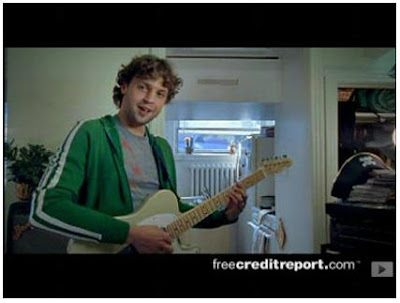
I wrote that title from memory, and I've only seen the new Freecreditreport.com ad three times. It's more catchy, and more memorable, than even Weezer's new song, Pork and Beans. In fact, I'm starting to wonder if someone from Weezer isn't writing those jingles.

I think the ads for Freecreditreport.com, where the young man sings about the woes bestowed upon him because he didn't know his credit was bad, are absolutely brilliant.

The first one, Pirate, was beginning to grate on my nerves, to the point where I'd change the channel when it came on — but it was always too late. Just like the horrendous Hotel California, all you need to hear is the first couple of notes and it's stuck in your head for the rest of the day.

Or week.

And then, just when I thought I couldn't stand to hear it one more time, along came the new one, Dream Girl, and damn it if I'm not hooked again.

The ads were created by The Martin Agency, of Richmond, Virginia. They're also the agency behind the Geico ads featuring James Lipton and Peter Frampton (which I also think are brilliant, especially the James Lipton one).

So they're entertaining: check. Memorable: check. Catchy: check. Clever: check. But what are the ads saying? What is the commercial message being communicated? Let's read the lines, and between them:

"I should have gone to Freecreditreport.com; I could have seen this comin' at me like an atom bomb."

The implication is, if only he had checked his credit... what? It wouldn't be bad? How does knowing you have bad credit change the fact that you have bad credit? The ads imply (and very well) that, somehow, using Freecreditreport.com would have prevented our hero from having to wait tables in a pirate costume (or drive a beat-up car, or live in his girlfriend's basement).

It usually surprises my students when I tell them, it's against the law for advertisements to lie. But it's true. You can't outright lie — but you can imply like hell.

That's why these ads are so brilliant. They imply that by signing up for Free Credit Report's monthly monitoring service, that you won't have bad credit. Of course that's not true at all, but people believe what they want to believe, and they want to believe there's an easy solution to the problem of bad credit.

Oh — the ads also imply that the service is free. It's not.

You can watch all three Free Credit Report ads here.

July 8, 2008

But is it safe to take it in the bathtub?

I just received an email from Amazon announcing its new electronic book reader, Kindle. "Reads like paper!" they claim. Uh, yeah, right.

Didn't they try this about ten years ago? I swear I downloaded a Stephen King e-book. It's probably still on my old IBM Thinkpad, which I can't bear to throw away. Just in case, you know, some day it becomes a valuable antique. Or I remember where I put that first screenplay I wrote.

No surprise to geeks and geek lovers eveywhere, one of the first Kindle titles available is Snowcrash.

July 1, 2008

Music, the Internet, and Pop Culture

I've been a subscriber to David Strom's Web Informant since before it was a blog; since before there was such a thing as blogs. I still get it delivered via email, and today his essay was about pop culture, and how soon we'll need a dictionary to keep up with it. To prove his point he linked to the new Weezer video, Pork & Beans.

Wal-Mart is America's largest music retailer, and as such wields a great deal of power. They refuse to carry CDs with images or lyrics their company disapproves of. They refused to carry Sheryl Crow's CD because the lyrics of one of her songs went like this: "Watch out sister/Watch out brother/Watch our children as they kill each other/with a gun they bought at the Wal-Mart discount stores." Is that right? If not, what can be done about it?

And finally, in memory of George Carlin, should his seven words you can never say on television be permitted on television?

June 29, 2008

Was that really Mary Darling commenting on our class?

Many of you wrote blog posts last week about Little Mosque on the Prairie, but only one, Wilson Ramirez's, generated a response from Mary Darling, the show's executive producer.

Wow!

The Internet skeptic in me wants to know if that was really her, or just someone claiming to be her. Ms. Darling, was that really you?

If it was really you, and you're reading this, to answer your question we are at San Jose State University, and the class is called Electronic Media and Culture. I'm Canadian, and if you saw Mike Myers on The Daily Show last week promoting his new movie, The Love Guru, then you know about our subversive movement down here in the States. I'm proud to be doing my part.

June 24, 2008

Critical Film Analysis: Writing a Movie Review

We're going to spend two classes (Wednesday and next Monday) on the topic of movies as cultural education. If you haven't already done so, have a listen to Tim Robbins and Edward R. Murrow again (clips are here). They were talking about television, but their points apply to movies as well.

Sure, movies can be pure entertainment, but the best ones are usually more than that. They make us think about our society and culture, question what is, and wonder what might be. They are, in a subversive sort of way, educational.

Your mandatory blog writing assignment for next week will be to write a movie review. You may choose either Kramer vs. Kramer, Brokeback Mountain, or Guess Who's Coming to Dinner — or another movie of your choosing in the same vein. The vein is this: these movies educates us about a way of life we might not be familiar with, and in doing so attempt to make us more accepting of them. In your review, I want you to critique the film from that perspective.

In the second half of Wednesday's class we'll watch Guess Who's Coming to Dinner, and on Monday, Kramer vs. Kramer. Here are some other links we'll be using in class:

Roger Ebert's review of Titanic
How to write a movie review
Classroom viewing of Brokeback Mountain brings lawsuit
Viewpoint: Censorship money is not worth it
Roger Ebert's review of Brokeback Mountain

June 23, 2008

For your consideration this Monday

For your consideration, from the Los Angeles Times, May 26, 2008: Broadcast networks under seige by Scott Collins. Did the writer's strike signal the death of broadcast television as we know (or knew) it? How do you consume broadcast media (radio & television), and has that changed in the last year or two? Do you watch TV online? Listen to your favorite radio station online? Do you wait until your favorite shows come out on DVD and watch them that way? Download them from iTunes or some other site? Do you watch TV on your iPod or cell phone?

For your consideration: Hulu. What do you think of it?

For your consideration: Tim Robbins's keynote speech at the National Broadcasters Association, April 14, 2008. Watch the first few minutes here. Read the full text here.

For your consideration: Does Tim Robbins's speech remind you of anything?

For your consideration: Little Mosque on the Prairie.

For your consideration: The Telecommunications Act of 1996. You can read the full text on the FCC's website, but you're not likely to want to. Instead, consider the FCC's report on the steps taken to implement the act. The most contentious of which are these: The order eliminating the national broadcast radio ownership limits; and the order eliminating numerical limits on national broadcast television ownership. Consider as an example: the Walt Disney Company owns ABC, which includes the television network and all these radio stations. What do you think will air on all those news programs if something bad happens at a Disney theme park?

For your consideration: Satellite radio is a $2 billion business that charges people for something they were used to getting for free. Are you willing to pay for it? Do you think it will succeed? What do you think the radioscape will look like ten years from now?

For your consideration: In the early days of radio its advocates promoted it as the great democratizing medium. (The same was said about the Internet 80 years later.) Do you think radio can be democratic in light of the deregulation that allows a few large media conglomerates to own most radio stations? Can a medium that charges subscribers be democratic?

For your consideration: The FCC regulates "terrestrial" radio but not satellite radio. Do you think that's right?

For your consideration: The FCC says this about its regulation of broadcast and cable television: "FCC rules generally do not govern the selection of programming that is broadcast. The main exceptions are: restrictions on indecent programming, limits on the number of commercials aired during children's programming, and rules involving candidates for public office." I can't seem to find, on the FCC website, a definition of obscene or indecent programming. Can you? How do they decide whether something is obscene or indecent? (Interesting article in the New York Times asks the same question.)

June 22, 2008

I have GOT to watch South Park more often!

Thank you Wilson for the link:

Something's in the air, all right

It puts me in mind of country roads back in my homeland, the farms of Southern Ontario, where the fragrance makes you want to roll your windows up.

Last Friday at the Cannes International Advertising Festival, the most prestigious, most coveted prize, the Grand Prix for film, was awarded. This is Fallon London's synopsis of their entry, "Gorilla," which took the prize:

"We hear 'In the air tonight' by Phil Collins as we realize we're in front of a calm looking gorilla. 'I've been waiting for this moment for all of my life…' The ape stretches its neck like a heavyweight boxer would do before a fight. He's sitting in front of a massive drum kit as the best drum fill of the history of rock is coming. The Gorilla knows this. He smashes the drums phenomenally - feeling every beat. The camera leaves the ape and his drum. United, the way they are meant to be."

Huh?

This ad isn't postmodern, it's just ridiculous.


The problem, for me, is that it's not a gorilla, it's a guy in a gorilla suit — I mean, that's obvious, isn't it? Does anyone really believe for one second that it's a real gorilla?

And don't say of course not. Go ask your English teacher what suspension of disbelief means. In order for us, the audience, to believe the story (and a good advertisement is simply a very concisely told story) we must believe that what we are seeing is possible.

I believed the apes in Planet of the Apes. I believed the Borg, and Q. I didn't believe Julia Roberts in Mary Reilly (or in Michael Collins, for that matter).

The gorilla in this ad might as well be wearing a Julia Roberts suit.

June 18, 2008

For John McCain, it's not Easy Being Green

(With apologies to Kermit the Frog.)

I just read an interesting article in AdAge called "McCain Me-Tooism on Global Warming Is Not Convincing." It's a critique of McCain's latest advertisement. The author, Ken Wheaton, writes:
John McCain has a new ad out emphasizing the environment. I won't dwell on the fact that Team McCain once again is using B-roll and music that should give even the most conservative art director a heart attack... But I will dwell on the content of the ad, such as it is. John McCain, the viewer is informed, "sounded the alarm on global warming five years ago." It's one thing to claim McCain broke with George W. Bush -- which he did -- it's another to claim that McCain was sounding an alarm about global warming in 2003. If I remember correctly, the alarms had long been sounded by then. So bragging about sounding the alarm sort of puts me in mind of Al Gore inventing the internet.

Watch: